The Hostage and the Elf Pirate: Chapters 1 & 2

Chapter 1

Kildran had never orchestrated a kidnapping before.

He crouched in the shadows under the decoratively pruned hedges, gaze flicking from the extravagant house to the shadowy yard to the street beyond. Grooms went about their business, unhitching the horses and putting the carriage away, never once noticing him. They wouldn’t, given that he wore the magict necklace that settled invisibility over him like a shroud. Even without it, he doubted they’d notice a solitary, dark-clothed elf remaining perfectly still in the darkest shadows, without moving for hours. By now his muscles were getting stiff, but he resisted the urge to stretch.

Not much longer now. The staff had nearly finished their work for the night, and already, lights were snuffed in various rooms of the house. A few still burned, however, including the one in the room he was watching.

Time stretched. The bustle around the stable faded. Not a single being stirred out of doors. The house was dark… except for that one room.

Kildran frowned. He’d been informed that this would be the best time to enact the plan, when exhaustion from dancing had everyone sleeping deeply. So why was she not asleep?

He sighed and settled in to wait longer. What did it matter if he stole her away at one o’clock or three? He already knew he wouldn’t be sleeping tonight, and as long as he had her back to the boat before first light, no one would know.

***

Missy paced her room restlessly. She’d long since let her maid go for the evening, having been helped out of her ballgown and into her shift. Her bare feet sank into the plush carpet, making no sound. Only the faint ticking of the grandfather clock downstairs reached her, giving rhythm to the music that still played within her head. She gave a little twirl across her floor, smiling.

The ball had been lovely, just like any event hosted by Lady Billingsley. There were too many unpleasant social dynamics to let herself fully enjoy any event involving her aunt and uncle, but she couldn’t deny that her aunt knew how to throw a party. And the fact that the ball had been thrown for her couldn’t help but soften her toward her aunt, just a little.

Of course, she knew Lady Billingsley had her own motives for offering to host Missy’s betrothal ball. The scandal of her cousin Margot’s disappearance four years ago had tainted the Billingsley name, and Lady Billingsley had been trying to claw her way back into social favor ever since.

Missy wished Margot could have been at the ball. It hardly seemed fair that they’d never been in a ballroom together, since Margot had left before Missy was old enough to attend them. But they’d always met the next day, cozying up in one of their bedrooms, sitting on the bed and hugging pillows or eating snacks while Margot described the evening in such detail that Missy felt like she’d been there too. Now it was Missy’s turn to want to describe everything for her cousin.

She knew Margot would have admired her dress—it was impossible not to, as it was a masterpiece of pale blue silk and lace, with delicate rosettes scattered tastefully among pearls. Her hair had been curled and pinned with pearls and ribbon rosettes as well, and she’d seen for herself in the mirror how the color had made her blue eyes look even bigger and brighter than usual. Missy hoped she wasn’t dreadfully vain, but she knew her eyes were one of her best features, unlike her boring brown hair. But overall, she’d thought she presented quite well, and everyone had said how lovely she’d looked.

Lord Cowell had been particularly effusive in his compliments, as her new fiancé ought to be. She smiled and wondered what Margot would think of him. He was older, already thirty-seven as compared to Missy’s nineteen—nearly twenty, in only two weeks—but he still cut such a dashing figure. He was tall and lean and polished, blond and clean-shaven, with green eyes and the most charming smile. There might have been a hint of gray fading the gold in his hair, and deepening creases at the corners of his eyes and around his mouth, but Missy thought that only made him look more distinguished.

He was all pleasantness and politeness and charm, and Missy felt delightfully fluttery at his attentions. She might wish secretly that she could know him a bit better, beyond the surface interactions they’d been allowed with a chaperone or in a ballroom, but that was what the engagement period was for, what marriage was for. She’d have a whole lifetime to get to know him.

Missy paced another turn around the room, remembering the only salt in an otherwise perfect day. She’d been dancing with Lord Cowell after the betrothal was announced—a waltz, which gave them plenty of opportunity for speaking—and he’d mentioned that he’d be leaving again for a brief trip in a few days.

Missy was unsurprised; as Her Majesty’s Lord of Commerce, he often traveled throughout the human kingdom and beyond. She did not resent it—if anything, she envied him the ability to see the world. She’d never once left Queensbridge.

“Soon enough,” she’d ventured, “when we’re married, I look forward to traveling with you.”

She’d held her breath—as best as one can while dancing—because not only had she mentioned their future together, it was the first time she’d alluded to her deepest dream of seeing more of the world. Only Margot knew how long Missy had dreamed of exploring new places. The hope of being able to travel with her husband was a definite factor in her acceptance of his proposal.

Lord Cowell’s charming smile had remained in place, but it took on something of a patronizing air. “Of course, dearest.” He leaned in until his breath came warm on her ear, lowering his voice to say, “Until you must stay home with the children.”

Missy had fixed her own smile before he’d pulled back enough to see it, but a thread of disappointment had wound around her heart. His tone had been suggestive, and she could have taken it that way, as a flirtatious hint about making babies. Instead, she’d heard the word “must” and flinched against it. She truly despised that word. She didn’t see why she must do any such thing. Yes, if they had children, she might choose to stay home with them, but perhaps instead she’d choose to bring them along. What mattered was that, when the time came, they’d decide together. No musts. No unilateral declarations that her dream was to be set aside.

She sighed. She knew he hadn’t meant it that way. He’d been trying to flirt, although this attempt hadn’t gone as well as all of his previous ones. He’d said, “Of course,” to her traveling with him—that was what Missy should be grasping onto. She had plenty of time to win him over to her way of thinking. That was what she did best, after all. Spoiled as she may be for it, Missy could nearly always get her way.

She flopped backward onto the bed, staring at the ceiling and wishing again that she could talk to Margot about all of this. Her fingers ran over the locket at her neck, which she’d removed for the ball but replaced immediately afterward. She’d been wearing Margot’s gift daily since her disappearance. If anyone would understand trouble with overbearing and patronizing men, it was her cousin.

Margot had been promised against her will to Lord Gruntmore—Missy’s nickname for him—who was lewd and controlling and much too old for her, without even the redeeming quality of retaining dashing good looks. She’d disappeared two nights before the wedding was supposed to take place, fleeing into the night with the mysterious elf she’d fallen in love with.

Not that Missy wanted to make the same choice. She had no intention of running away. Her life was lining up perfectly, despite her uncertain hope that her husband-to-be would be as eager to have her by his side on his journeys as she was to be with him.

Everything would work out. She’d win him over. And in the meantime, she’d write a letter to Margot.

She was fairly certain that Lord and Lady Billingsley still had no idea where their daughter was, but Missy had exchanged several clandestine letters a year with her cousin since she’d left. She suspected that Mama and Papa knew about the letters—she wasn’t half as good at keeping secrets as Margot, though she’d loyally kept mum about Margot’s baking and her elf.

But though her parents would stand in solidarity with Papa’s brother and pretend in the eyes of society that Margot had never existed, Missy knew they still loved Margot and wished her well. So if they knew about the letters, they willingly turned a blind eye, as long as Missy made the smallest effort to be stealthy about sending them.

Tomorrow, though. She’d write tomorrow. Now that she’d stopped pacing, the long day, late night, excitement, and exercise all caught up to her. Suddenly exhausted, she didn’t even bother to stand and climb into bed properly. She half leaned sideways so that she could blow out the candle on her bedside table then flopped backward again, yanking the other side of the blankets until they folded over her, wrong way out. Minutes later, she was out cold, dreaming of dancing and letters and lockets.

***

At last.

Her light was out.

Kildran stayed where he was, poised but patient, until another twenty minutes had passed. Then he crept to the front wall of the house, keeping to the shadows despite knowing his magict would hide him.

The girl’s window opened onto a wide ledge, practically a balcony, supported by the decorative marble columns flanking the front door. Kildran wished her room were at the back of the house so there was no risk of a witness from the street, but his invisibility meant that, for now, there was nothing to witness. And there was no one on the street.

He shinnied up the column, grateful at least that he didn’t have to break in and navigate the extensive corridors a place like this would have. It was a ridiculous building. Superfluous—but with convenient decorative touches that made it easy for him to scale the column, slide onto the ledge, and easily open the window. Better yet, the girl’s room was carpeted, so he landed even more soundlessly than he would have if the floor were bare.

He paused just inside the window, letting his eyes adjust to the darker shadow, as only minimal starlight could reach in here. A shape lay bundled on the bed, and he crept to her side, peering closely to make sure she was the one he was after. Dark hair tumbled across her pillow. A young face, peaceful in sleep. Kildran drew the magict blanket from his bag and carefully peeled her own covers off, replacing them with his. Once she was under it, he knew she wouldn’t wake, but the transition was a risk.

The girl merely sighed and nestled deeper into her pillow.

Kildran’s mouth turned up in satisfaction. Other than the late start, this was smooth sailing.

Before he scooped her up, his eye caught on a dark shape in the corner. After a moment, he made out that it was a chair with a dress draped over the back. On impulse, he swiped the dress and stuffed it into his bag, assuming she’d be in her night things and wouldn’t appreciate having no daytime clothing. He didn’t have much experience with humans or women, but he could guess that much.

That settled, he maneuvered her into his arms, wrapping the magict blanket more securely around her. At the window, he hoisted her over his shoulder, glad for her sake that she was sleeping through the indignity and discomfort, and gracefully returned the way he’d come. Once on the ground, he rearranged his sleeping cargo again so that he held her to his chest before slipping silently away from the house, toward the dock and the boat that would take them from Queensbridge.

Chapter 2

When Missy woke, she was not in her own bed. Nor in her own room. She blinked blearily around, trying to make sense of it.

She was lying on what seemed to be a wooden bunk built into one wall of the room, padded with a thin mattress and covered by a soft woolen blanket. But it wasn’t her woolen blanket—it was solid emerald, not creamy white and embroidered with pink and yellow roses. Another bunk lay against the opposite wall, with a similar blanket folded neatly at its foot. Beneath the other bunk, and she assumed beneath her own, though she hadn’t yet sat up to check, there was a kind of wooden locker with a handle and two sets of doors that could swing open.

That was the extent of actual furnishings in the room, and to be truthful, it couldn’t have held much more. It was a cramped space, not even half the size of her bedroom at home. What made it even more cramped was the heaping stack of crates and barrels and trunks that lined a third wall. Missy thought from the way light faintly glowed from that end of the room that there were windows somewhere behind the pile.

She sat up, pushing the blanket off and swinging her legs over the side of the bed. She pressed her hands into the mattress beside her, digging her fingers into the solidity of the wood beneath. Her mind struggled to grasp what her eyes were telling her plainly: she was not at home.

But how? And why?

And how?

Perhaps she was ill. Feverishly delirious. The way the room pitched and swayed around her supported that theory. She was ill and dizzy, and it was affecting her dreams.

Except the solid wood beneath her fingertips and the smooth plank floor under her bare feet were too real to be a dream. She traced one finger along the line where the mattress met the wooden bunk beneath.

Not dreaming, then. Probably not delirious either, because she didn’t feel feverish. She felt surprisingly well rested and perfectly normal, aside from the depth of her confusion.

And despite the rolling motion of the room, she suffered from neither dizziness nor nausea. It was actually rather soothing, like when Mama used to rock her in the rocking chair at bedtime, or like reclining in a hammock in the shade on a lazy summer day. If it weren’t for the panic rising in her throat, she would find it pleasant.

But panic was tightening her chest. In a moment, it was too much, and Missy shot to her feet and dashed the few steps to the door in the one narrow, blank wall. Whatever horrendously unfamiliar situation she’d ended up in, she needed to know more, and the only way to find out was to see what was outside.

The door was locked.

Now panic sizzled through every limb until it tingled in her fingers and toes and burned at the backs of her eyes. Missy pounded on the door.

“Let me out!” she hollered. “Help!”

She thought she might have heard a faint shuffling on the other side of the door, but it may have only been her heartbeat pounding in her ears.

“Is anyone there? Let me out!” She continued to pound on the door until her hand ached, and then she tried the latch again, but it was still as locked as ever.

She was choking back the threatening tears and scanning the room for something she could use to pry the door open, knock it down, or break it to pieces—she wasn’t picky—she just needed out—when a soft knock came from the other side, and she sobbed in relief.

“Miss Fisher?”

“Please!” Missy cried, unsure what she was even begging for. Just open the door, whoever you are. I don’t care what comes after.

The lock clicked, and Missy had just enough wherewithal to take a step back from the door before it swung inward. She was desperate enough that she nearly flung herself on her rescuer, but she clenched her fists at her sides and held herself steady.

And good thing too. Because the doorframe was filled by the last thing she expected.

Taller than she by nearly a foot, and broader to match, an elf watched her from eyes like deepest, darkest night. His hair was black as well, tied at his neck with a strip of leather to expose his pointed ears, contrasting sharply with his fair skin and white linen shirt. He wore a long, curved sword at his hip, which Missy found herself gaping at, having previously only come in contact with the decorative ceremonial sabres the lords wore for special occasions.

His face was all clean lines and stern angles, expressionless and stoic but devastatingly handsome. If this was what elves looked like, she couldn’t blame Margot for falling for one. It was a wonder women didn’t abandon human men completely for this gorgeous race. She cringed internally at her mental disloyalty. She may not have had a fiancé for long, but she had one now.

Silently, the elf held out the bundle of fabric he was holding. Missy took it and shook it out, recognizing the dress her maid had laid out for the morning. She frowned.

“How…?” She turned her frown on the elf, allowing it to deepen into a scowl as the truth of her situation began to sink in. “Did you…?” More truth inched through her confusion, as she was suddenly aware that she was staring down the most intimidating figure she’d ever seen while wearing nothing more than her shift.

“Welcome to the Dusk Runner, Miss Fisher. You will be our guest until such time as your fiancé chooses to ransom you.”

Missy’s mouth fell open. “You kidnapped me!” she gasped.

A corner of the elf’s mouth quirked. “Rather easily, too.”

Incensed and mortified, Missy slammed the door in his face. She couldn’t lock the door from this side, so she leaned heavily against the wood to make sure he couldn’t push it open again. When a full minute had passed and it was clear that he would leave her alone, she straightened with a shaky inhale.

She began to dress, her mind spinning, shaking off the befuddling fog. She’d been kidnapped—by elves—to be held for ransom. And not from her father or even her uncle, Lord Billingsley, but from Lord Cowell. Why? What issue could elves have with the human Lord of Commerce?

Oh.

She hadn’t just been kidnapped by elves. They were pirates. That explained the motion of the room. She was on a ship. A pirate ship.

Snatches of conversation she’d overheard about pirates plundering merchant ships and Lord Cowell enacting measures against them came to mind as she slipped her arms into her sleeves and struggled to tighten the laces at the back of the dress. Whatever Lord Cowell had done to try to stamp out piracy, it seemed these particular pirates didn’t want to be stamped out. And Missy was caught in the middle.

“What a nightmare,” she muttered to herself.

And she meant every bit of it—the pirates and the kidnapping, of course, but also trying to get her laces tied without someone to help her, and, worse, having just the dress without the corset and underdress and petticoat. She felt dreadfully exposed, despite the fabric covering her. Her feet were exposed, as she had no stockings or shoes. Her hair hung loose down her back, a style a lady stopped wearing once she was old enough to be out in society. Missy had sat for half an hour every morning to have her hair braided or curled and pinned up for the day ever since she’d turned seventeen. Today she had no maid, no brush, and no idea how to deal with it.

Another deep, shaky breath; another gulping back of threatening tears. She’d never wanted an adventure, but apparently she was having one, and she always hated when the heroines in books were watering pots. She refused to be one herself. Fiercely, she combed through her hair with her fingers, wrestling with tangles until she could braid it in one long plait down her back. She had nothing to tie it with, so it would likely unravel before long, but it was better than nothing.

Looking around the room one more time, Missy decided that there was nothing more she could do to make herself presentable—not that the elves deserved any consideration, but she refused to be turned out less well than she could be. The door remained unlocked, and now she opened it cautiously.

The intimidating elf who’d kidnapped her was nowhere to be seen. Instead, another figure leaned casually against the wooden wall of the narrow hall. He straightened when he saw her, and they stood silently, studying each other. He was shorter than the first elf had been—only by a few inches, but enough that it made him about of a height with her uncle. His brown hair was cropped close, revealing a short, pale scar that ran from the right corner of his jaw to just below his ear. Another scar cut across his left cheek. He wore a kind of leather brace or harness across his chest, and over his shoulders she could see the gleaming hilts of two matching short swords or long daggers or something equally deadly. The obvious signs of combat experience should have made him frightening, but his height and lean build made him less overtly intimidating, and a small smile softened his expression.

“Miss Fisher, I presume?”

“I am.”

“Breakfast awaits, if you’d like.”

Missy wouldn’t have said she was hungry, but at the mention of breakfast, her stomach rumbled. “Thank you,” she said politely, minding her manners as a lady should, regardless of circumstances. “How long did I sleep?” The real question: When was I abducted?

“Three nights and the days between,” her new companion said as he turned and guided her to a ladder at the end of the corridor.

Missy stumbled over her own bare feet. Three nights? She’d never imagined sleeping that long in her life, not even when she’d contracted influenza when she was a child.

“Magic,” she whispered. It was the only explanation.

“Yes,” her guide agreed but did not clarify.

Magic was rare enough that Missy hadn’t come across it herself before. It was only usable in the form of objects enchanted by wizards, and those were rare and dearly expensive. Margot had told her of a pair of hourglasses Alvon had used when he came to secretly court her, but she didn’t know anyone else who had one. She supposed a pirate’s job was to amass wealth, however, so perhaps she shouldn’t be surprised that they had access to a useful magict.

The elf scaled the ladder and then stood aside at the top to allow her to emerge behind him, holding out a hand to help her onto the deck. She stared, wide-eyed, at the bustle around her.

At least two dozen elves were busy at work, with ropes and canvas and any number of other things. There was simply too much to take in all at once. What struck her most forcefully was how unexpectedly small the ship was—not even the full length of her family’s house in Queensbridge, and only about as wide as their drawing room. Missy didn’t quite know what she’d been expecting, but for a group as larger-than-life as pirates, she’d pictured their ships to be larger-than-life as well.

The nearest sailors cast her curious looks, and a few murmured to each other, but no one approached. All were tall—most taller than her current companion—and graceful and beautiful, and many were decorated with scars of varying lengths and severity.

From the corner of her eye, Missy caught a figure emerging out of the shadow of the raised poop deck behind them. She turned and let out a short shriek, her heart racing in panic again.

The person was a full head taller than all the others on deck, and broader to match, and he seemed to be built of solid stone, his flesh—if it was flesh—gray and craggy. His dark hair was knotted up on top of his head in a utilitarian version of the bun some women wore. His eyes, a darker gray, were unreadable as he handed her guide a plate, gave her a single, tight nod, and walked away.

“He’s not the easiest to look at, but he’s a good elf,” her companion said.

“He’s a rock troll!” Missy exclaimed, struggling to lower her voice.

“Half.”

Missy gaped after the half-rock-troll’s retreating back.

“Breakfast?”

He held the plate out to her, and she took it without thinking, dragging her attention back to the food her stomach was demanding. The contents of the plate were simple—bread spread with honey and slices of a star-shaped fruit she’d never seen before—but Missy was too ravenous to complain. She ate half the bread in two bites, forcing herself to pause and chew before she choked herself.

“What is your name?” she asked after she’d swallowed.

“Brandor.” The elf sketched a half-bow, graceful as every other movement he made. “First mate.”

She nodded, taking another bite, her eyes drifting back to where the stone-gray half-elf was coiling a probably enormously heavy rope with two others, making it look as if it were as light as silk ribbon.

“His name is Cosar,” Brandor offered. “And you’ve met the captain.”

Missy glanced hastily around the deck for the black-haired elf she’d met first, but he was nowhere in sight. She relaxed and ate a piece of the star fruit, humming in delight as the sweetness burst on her tongue.

Once she’d finished the food, Brandor took the plate from her and set it atop a barrel nearby. She surveyed the deck and the crew, still hard at work, and asked, with only the slightest quiver of fear in her voice, “What is expected of me?” At Brandor’s furrowed brow, she added, “I’ve never been kidnapped before, nor held for ransom. I’m not quite sure what it entails.”

“You wait.” Brandor’s mouth curved into that small smile, more emotion than she’d seen from anyone else aboard this ship so far. “And then you wait some more.”

Missy frowned. She hated waiting. “Wait for what?”

“First, we’ll give everyone a bit of time to miss you and to worry for your safety. Once they’re well riled, a message will be sent to your dear Lord of Commerce with our terms.” Brandor shrugged. “Then it’s up to him how long he takes to meet them.”

“So until then, I’m just… here? Doing nothing?” Not that she’d ever thought kidnapping fun, but whatever luster it had was fading quickly.

“At least the view is good.”

Brandor waved to the side, and Missy turned to look where he indicated. She gasped, her feet carrying her unbidden to the rail. Water gleamed blue and silver for miles upon miles, as far as she could see, rippling and glittering in the morning sunlight. The sky looked equally huge, meeting the waves in the farthest distance. How had she missed this? Who cared about the running of a pirate ship—or even about breakfast—when there was a view like this to be seen?

She clung to the rail, needing to feel grounded again. This was a dream, surely. Seeing the Faren Sea was one of the most secret, precious dreams she’d held, and here she was, and it was more than she’d ever imagined.

Everything about it was more—more sunlight reflecting on the water, more rolling of the ship over waves, more wind tugging her hair from its braid, more salt scent in the air. More water. More sky.

Brandor seemed to understand that she needed time to take it in, because he moved a few paces away. She could hear him talking in a low voice to another sailor, but no one addressed her.

Missy didn’t know how long she’d been standing there, gazing in awe and half afraid to blink for fear it would disappear, when she felt a looming shape beside her. She glanced up and flinched, then tried to hide it by pushing loose hair from her face.

“You are Cosar, am I correct?” she asked her new neighbor, darting a look over her shoulder for Brandor, who was no longer nearby.

The stone-faced giant beside her nodded silently.

“I’m, er, sorry I screamed when I first saw you,” she ventured after a moment.

The shoulder nearest to her twitched slightly, not quite a shrug. “Not the first time it’s happened.”

That only made Missy feel worse. “This morning has been…” She huffed a laugh and shook her head. “It’s been a lot. But that was rude of me. I apologize.”

Cosar gave a single nod, never once looking at her. Missy took that as permission to go back to staring at the water.

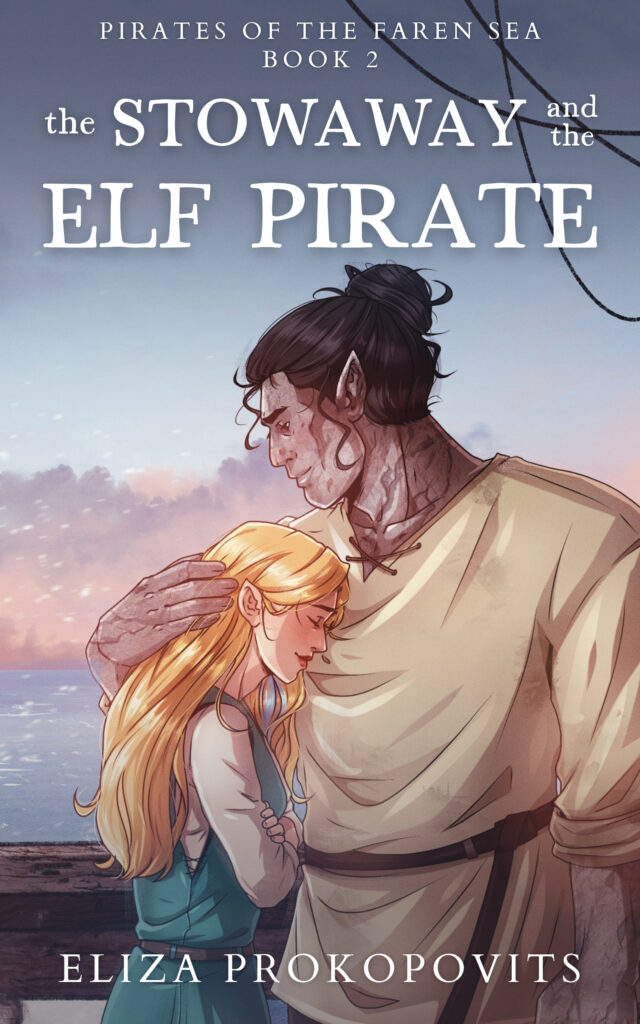
The Stowaway and the Elf Pirate

She doesn’t intend to stow away…

Tris just wants to escape her village where she’s watched everyone age and die while she stayed young and miserable. Sneaking aboard an elven pirate ship seems like the only way to find the belonging she desperately craves.

How many good deeds does it take to atone for existing?

For Cosar it’s always one more. For years that has meant wholehearted loyalty to Captain Kildran and the crew of the Dusk Runner. So when he finds Tris stowed away, Cosar immediately seeks to protect them from her, suspecting that she’s a bounty hunter with a lethal motive.

Can Tris earn her place on the crew before she’s abandoned yet again? Can Cosar learn to trust her—and question the lies declaring him unworthy of love—before he pushes away the one person who is beginning to feel like home?

The Stowaway and the Elf Pirate will be available on January 20, 2027. Preorder now on Amazon and other retailers.

Winning Cora – Chapters 1 & 2

Chapter 1

Wyoming Territory, March, 1883

Cora placed the cup of coffee in front of their visitor and took a seat on the bench that lined one side of the wooden table, trying not to begrudge him some of their dwindling stores. They were neighbors, after all, and hospitality was important.

Craig MacLeod, seated beside her on the bench, was a burly Scottish immigrant, somewhere around forty-five years old, with carroty red hair streaked with silver. His face was lined from years of hard work in all rough conditions, but his brown eyes were friendly. Cora’s parents had always gotten on well with the MacLeods, so when he drove up unexpectedly this morning asking to speak with her, she’d welcomed him in.

Spring was barely underway, the snow only just thawing enough to follow the unmarked road between homesteads. A week ago, he couldn’t have made the trip at all.

Cora’s brother, Carter, sat in his customary chair at the head of the table, leaning back, arms crossed over his chest. His expression was stoic, unreadable, but that was standard for Carter. He was never emotional, but she wished for a brief moment that she could tell what he was thinking about their unexpected guest.

“I won’t lie to you, Miss Hewitt,” Mr. MacLeod said, twisting the coffee cup between his big, calloused hands. “We’re in a right state over at our place now that Mary’s gone. Made it through the winter alright since she’d set us up well before she passed, but it’s been a challenge keeping up with chores and the wee ones. And my cooking’s nothing to write home about. I kept us alive, but…”

He shrugged and glanced toward the door. Beyond it, his four children, all under the age of ten, were playing in the muddy yard under the supervision of Cora’s younger sister, Maisie. He studied his coffee for a minute then sighed and met Cora’s eyes.

“We need a woman in the house. I can’t manage it all alone, and the cooking and preserving and whatnot—it’s more’n I know how to do. So I’m here to ask you to marry me.”

Cora blinked at him. She sure hadn’t expected that when he’d arrived. His wife had been gone six months, and she believed every word of how difficult those months had been. She’d noticed that the children’s clothing was wearing thin at the elbows and knees, and the older girls’ hair looked like it had been brushed through with someone’s fingers rather than an actual comb before being tied haphazardly with scraps of cotton. She didn’t doubt that his family needed a woman to fill the roles of wife, mother, housekeeper, cook, and general caretaker. But much as she respected Mr. MacLeod as a neighbor, she had no interest in filling that role herself.

“I’m honored you thought of me,” she said slowly, darting another glance at her still-impassive brother. “Mary’s shoes are not easy ones to fill. But I’m afraid I’m not looking to marry at the moment. My family needs me here. Perhaps you’d consider a mail-order bride?” she offered. “I’ve heard that several men in town are happy with theirs.”

MacLeod frowned and rubbed his stubbled chin. “I’ve heard that too, but you never know what you’ll get with one of those. Last thing I need’s a city girl who knows nothing of bairns. You’re a good woman, and you’d make a man a good wife. Sure you won’t reconsider?”

Cora nodded. “I’m sure. But thank you.”

MacLeod nodded, drained his coffee, and got to his feet. “We’d best be off then. There’s bound to be at least one more storm coming before spring’s here for good.”

Cora took his cup to the sink and washed it while Carter walked the man out. She peeked through the window as her siblings helped the young children climb into the back of the wagon. This wasn’t the first proposal of marriage she’d received in the last few years, and it wasn’t likely to be the last. Craig MacLeod wasn’t a bad man, and he’d have treated her well. But while his pragmatic approach to marriage might work for some, it wasn’t enough to convince Cora to give up the life she had.

She couldn’t imagine him lovingly rubbing her tired feet after a long day or stealing kisses in the barn during chores like she’d seen her parents do. A marriage between them wouldn’t include his arm around her waist, snugging her into his side, or her head resting contentedly on his shoulder. They wouldn’t have that bottomless affection or playful teasing that her parents had modeled. And while no one had ever told Cora what to look for in a relationship, she’d seen it daily for most of her life.

She leaned her hip against the edge of the sink, absently drying her hands on the towel as she watched out the window. The poor, motherless MacLeod children did tug at her heart. But as much as she liked being needed, she already had her own siblings to look after. When Ma and Pa had died of a fever five years ago, her last promise to Ma had been to take care of Carter and Maisie.

Carter, then twenty-one and already working hard around the farm, would work himself into the ground and forget to eat or sleep if someone didn’t remind him, especially if he knew that his younger sisters’ wellbeing depended on the homestead’s success, and by default, on him. And he’d never give a hint that he was struggling.

Maisie had been only fifteen at the time. Cora, seventeen and barely a woman herself, had stepped into the role of mother for both of them. She made sure that everyone was fed and clothed, that the house was clean, that food was grown and stored for winter. Mr. MacLeod had been right that she was capable of what he was asking, but she’d never break her word to Ma and leave her family while they still needed her.

And maybe, a small part of her whispered, it would be nice to be wanted by her husband, rather than merely needed.

***

Cora had heard Sunday called a day of rest before, but she supposed that whoever had refused to work hadn’t been living on a homestead. Or maybe they didn’t count feeding the animals, milking, or gathering eggs as “work.” It was true that there were other chores they wouldn’t do on a Sunday, but it was also true that they were up at first light just like every other day.

Maisie threw on her work dress from the day before, shoving her feet into boots without bothering to tie the laces. She grabbed a leftover biscuit from dinner and followed Carter silently out to do barn chores. Cora watched the door close behind them with a wry smile. Her sister was cheerful and talkative most of the time, but before breakfast she could be as ornery as their older brother.

Cora pulled on her work clothes, too, but didn’t bother with shoes, liking the feel of the worn wooden planks beneath her bare feet as she shaped the dough she’d left rising overnight, even when spring still felt an awful lot like winter. She tossed her head to throw her braid back over her shoulder and out of the way. She set the loaf aside to proof on the warming oven while she opened the last jar of preserved pears from last season and mixed flour, sugar, and oats with a bit of butter into a crumble topping. This all went into Ma’s favorite pie plate with the scalloped edging. Then the two pans went into the oven.

Cora shoved her feet into boots and darted across the yard, the mud frozen into hard ruts and ridges overnight, to get the basket of eggs Maisie left waiting for her at the door of the barn. She was grateful that it was Maisie’s turn to collect the eggs. She’d never complain to her siblings, but she secretly hated Bernice, the ornery alpha hen of the flock, and longed for the day it was her turn for the frying pan.

Scooping up the basket, she took a minute to pause and enjoy the crisp, early morning air chilling her lungs, the sun just peeking over the horizon. A disgruntled moo from inside the barn reminded her that chores were afoot, so she hurried back to the house to fry the eggs for breakfast. By the time they were ready, and she’d cleared off the mess she’d made of the table, her brother and sister were washing up to eat.

They sat together at the table, Carter at the head where Pa used to sit, and Maisie in Ma’s old chair. Cora placed the eggs and the rest of the leftover biscuits on the table along with a pat of butter and three cups of steaming coffee—little more than bitter water to try to make the rest of the grounds last until they could get to town for supplies. Then she slid onto the bench that she and her siblings used to sit on together.

Everything in this house reminded her of what life used to be like, and sometimes it made her breath catch and her eyes burn, but sometimes, like this morning, it wrapped her up like a warm quilt, all the years of joy and all the people who’d loved her. Carter muttered a short prayer of thanks, and they began to eat. Breakfast was always a silent meal, as Maisie wasn’t fully herself yet, and Carter spoke mostly in grunts and grumbles at any time of day. She missed the way he used to be—never as bubbly as Maisie, but… more alive. Happier.

After breakfast, Cora took the bread and pear crumble from the oven and set them on a folded towel on the table to cool while they changed into their Sunday best. Their best wasn’t anything fancy, just their newest clothes without the holes or the worn-thin areas. Maisie’s was a peach calico that brought out the golden highlights in her hair and made her cheeks glow. Cora’s was a deep blue patterned with tiny pink flowers and green leaves. She didn’t know what kind of magic was in the pink flowers, but they made her feel feminine and graceful, not sturdy and practical like she was most of the week. She twisted her hair up and secured it with a tortoiseshell comb of Ma’s.

“How do I look?” she asked Maisie. The only looking glass they had was Ma’s little handheld mirror, and Cora never trusted it to tell the whole story.

“It’s only the Brooks, Cor,” Maisie said without looking up from where she sat on the edge of the bed, tying her boots. “It’s not like they haven’t seen you looking your worst. Like that time you fell in mud trying to catch old Helen.”

Cora cringed at the memory of the milk cow who’d gotten out and decided to make a run for it. It had been after a full day of rain, and Cora had returned sodden, filthy, and in tears, pleading with Carter and the Brooks boys to come help her catch the wretched creature.

“Not helpful, Mais. I’d rather not be remembered like that.”

“I’m pretty certain none of us could forget it,” Maisie said with a grin, straightening.

Cora huffed and debated asking Carter instead, not that he’d be any more help.

“You look lovely,” her sister said, standing and coming to hug her. “Stop fussing. That dress brings out the green in your eyes, and I only wish I could get my hair to stay like that.”

“Would you like me to help with your hair?”

Maisie shook her head. She’d done her long brown hair into two braids and coiled them around her head like a crown. Her hair was so fine and silky that braiding it was the only way to keep it from sliding out of hairpins, and even then it was usually wisping everywhere and half fallen down by the end of the day. “No point in wasting time on a style that won’t last the morning.”

When they emerged from their shared bedroom, Carter was already outside preparing the horses. Cora carefully wrapped the bread and crumble in towels. She laid them neatly in a basket, tucking a jar of dill-pickled green beans alongside them. Then she and Maisie grabbed their hats and coats, and they hurried out the door. In the yard, both horses—Butter and Daffy, short for Daffodil, both named by Maisie for their golden coats—stood saddled and waiting with Carter at their heads. Maisie mounted Daffy and waited while Cora handed her brother the basket and mounted behind her. She’d rather walk than ride, especially since the saddle wasn’t made for two, but not until spring had fully arrived. Their Sunday best wouldn’t be their best for long with all that mud. Carter mounted Butter, holding the basket in front of him as they rode the well-worn path to their nearest neighbors.

The sun was well up on its morning climb when they reached the Brooks’ house. Eighteen-year-old Jilly opened the door and welcomed them all in, greeting the girls with hugs and Carter with a special smile. The sunlight caught her just right, making her blue eyes glitter and her strawberry-blonde hair glow pink. Carter barely acknowledged her, following Maisie into the kitchen with the basket of food. Cora gave Jilly an extra smile in apology for her brother.

Once everyone was inside, they all piled into the living room. The three girls took their customary spots on the sofa, with petite Ma Brooks in her rocker and lanky Pa Brooks in a chair brought in from the kitchen. Jilly’s older brothers, Jack and Grant, sat on the floor against the far wall, and Carter stood leaning against the kitchen doorframe, arms crossed.

Pa Brooks started by saying a prayer, then he read a chapter from Matthew, a psalm, and a chapter from Proverbs. They’d been doing Sunday service this way with their two families every week for as long as Cora could remember, even back when her father used to take turns being the one to read from the Bible. It wasn’t feasible to attend the nearest church five hours away, so they met here in the Brooks house, which had more space for everyone to fit in the same room.

The reading was followed by another prayer, and then they sang a few familiar hymns. Maisie’s voice was the strongest, though Cora and Jilly weren’t bad. Carter could carry a tune, but he never sang. Grant was always a bit off pitch, and Jack mostly hummed along, eyes half closed like he was listening to the words. Cora loved the way their voices all blended. It filled her with a sense of family that not much else had given her in the past few years. Yes, she had her siblings, but this, all of them, they belonged together.

After the little service, they moved to the kitchen, and Cora helped Ma Brooks lay out food on the table. Once the weather warmed enough, they’d take their meal outside on a blanket where they’d have a bit more space. For now, the table was crowded with fried chicken, mashed potatoes, bread and butter, and pickles. There were only enough chairs for half of them, and barely room for plates. Carter and the two Brooks boys ate standing up.

Most of the talk through the meal was about spring chores. Both homesteads had extensive vegetable gardens to plant, and the Brooks family had a growing flock of sheep that needed to be sheared before lambing.

“Before we all get too busy,” Cora put in, “I need to make a trip to town for supplies.”

We,” Carter corrected.

Cora wrinkled her nose at him but didn’t argue. Haven River Falls was the nearest town with a mercantile, but it was a five-hour drive from their homesteads. Add in the fact that, despite the recent growth of the town and the influx of new families and mail-order brides, men still outnumbered women by more than three to one…. Carter would never let Cora or Maisie near the town without him to protect them.

“We’ve run out of sugar and tea. I used the last of the salt this morning, and we have maybe one week’s supply of weak coffee left. And Carter’s even grumpier without it.” Her arched brows dared her brother to argue.

He merely grunted, and Ma Brooks laughed. “Grant doesn’t do well without his morning coffee either. We ran out a month ago.”

“I avoid him until about noon,” Jilly said in a loud whisper that she clearly meant for her brother to hear.

“We can’t all be sunshine in the morning,” Grant grumbled as Jack elbowed him in the side.

As the conversation devolved into good-natured ribbing, Cora got up and started serving the pear crumble. Jack’s plate was the last to appear in front of her, and after she’d dished his serving, he mumbled, “Could I have the, um, extra crumbs, please?”

Cora glanced up at him, noticing the pink tinge to his cheeks. She’d never quite understood how Jack could have ended up as shy as he was with outgoing siblings like Grant and Jilly. He was always polite to her, but he didn’t speak much. In truth, she hadn’t had many interactions with him besides Sunday mornings since they were children and both still doing lessons for part of the day under the instruction of one of their mothers. But he was three years older than she was, so he’d moved from indoor lessons to working with Pa Brooks and the sheep long before she’d left the schoolroom.

She scraped the last few bits of crumble from the pie plate and onto Jack’s serving.

“Thanks,” he said quietly, retreating to his spot against the wall to eat it.

Cora moved to the dry sink to start washing the used dishes, pouring cool water from the bucket by the door and steaming water from the kettle on the stove into the basin. The splash of water couldn’t quite drown out Maisie’s next words.

“Guess what happened to Cora yesterday.”

Cora half turned, her hands already wet and soapy. As expected, Maisie and Jilly had their heads together. The two had been thick as thieves for years, being the youngest of the group and in the schoolroom together the longest.

“Mais—” Cora protested, but it was no use.

“Mr. MacLeod proposed.”

Jilly gasped. “When? Where? How?”

A quick glance around the room showed that everyone was listening to the girls’ conversation. Cora cringed. She hated to be the center of attention, even though Maisie was the one telling the story, and she didn’t want poor Mr. MacLeod’s disappointment to be the subject of amusement. As there was no stopping her sister now, she purposely turned her back on the room and got to washing dishes.

“He drove out to the house, bringing all his kids along in the wagon.”

“He drove to the house?” Jilly sounded incredulous. Even Ma Brooks made a surprised humming sound. “That’s… new,” Jilly continued. “I mean, you get offers every time you walk down the street in Haven River Falls, but for someone to make a trip out here on purpose just to ask…”

“I reckon he’s finding it hard now without his wife,” Pa Brooks said calmly.

“Yep,” Carter acknowledged.

Cora was surprised that her brother contributed to the conversation at all. He hadn’t said anything to MacLeod himself.

“Gotta check Bandit,” Jack said abruptly. A second later he’d dropped his scraped-clean plate into the sink with a slight wet plop and vanished out the door. Cora frowned, confused, but then she heard what Jack must have heard first—faint barking from the barn. She returned to washing up and wishing she could ignore the talk behind her.

Chapter 2

Jack jogged to the barn. He was sure Bandit was barking at nothing, but it was a convenient excuse to get out of there. The situation felt uncomfortably familiar, and he didn’t like it one bit.

As he slid the barn door open, he flashed back five years. He’d just turned twenty; Cora had been seventeen. They’d been going about their lives, both working with their families on their respective homesteads. Ever since he’d quit schooling at fourteen, he hadn’t spent much time with her, but she was always there, always around.

And then the day Maisie had spoken up, much like today, announcing in a sing-song voice that Cora had a beau. Cora’s face had gone bright red, and Jack had the startling thought that she looked perfectly adorable flustered like that.

While Cora tried to shush her sister, Maisie and Mrs. Hewitt had spilled the news: Luke Opelski had come calling. The Opelski spread was one of the largest cattle ranches in the area, and Luke was the second son. He was older than Jack and Carter, in his mid-twenties, and ready to settle down with a good woman.

Apparently, a woman like Cora.

It had been an eye-opening moment for Jack. The fact that Cora was a woman shouldn’t have caught him so totally off guard, but it had. She was Carter’s little sister. She was friends with Jilly, who was still a kid herself. And yet, somehow, without him realizing, she’d grown up.

Once he’d noticed, he couldn’t stop noticing. The way her hazel eyes looked browner or greener depending on what she wore. The way a blush would turn her cheeks the color of strawberries. How her dresses hugged the curves he’d somehow missed seeing. How she worked hard, smiled often, and was always ready to help. Qualities he’d seen and absently admired without recognizing their impact.

Suddenly, Jack saw Cora—the real, entire, beautiful, grown-up Cora. And to see her was to love her. He was tumbling head over heels… silently and from a distance because she was courting Luke Opelski.

He’d been too late, too slow to recognize the incredible young woman who lived right next door. To have his heart fall and break simultaneously was more than he could handle on his own. Oddly, it was Jilly who’d helped him pull himself together.

Despite their seven-year age difference, they’d always been close. Maybe he’d treated her more like a doll or a plaything than he ought to when they were children, but it meant that he’d let her tag along and be his tiny, chatty shadow. And it meant that she often confided her bright, little secrets to him.

In the face of his despair, she’d confessed to having a crush on Carter, one that had already lasted several years. Somehow, knowing that he wasn’t the only one in unrequited love with one of the Hewitts made Jack’s load easier to bear.

It still wasn’t easy. Jack had always intended to continue working the homestead with Pa, eventually taking it over and having his own family there, maybe building another cabin on the property to give them a bit more room. But if Cora married Luke… Jack was looking at a future as the quiet, lonely, perpetually grumpy bachelor uncle to Grant’s and Jilly’s kids because he’d never be able to get Cora out of his heart enough to let someone else into it.

It was a bleak prospect, but nothing to the pain of watching the girls giggle together over Cora’s romance as they did their chores around the homesteads and seeing Cora blush over another man.

After a few months of torment, however, worse happened: Mr. and Mrs. Hewitt both died of a fever within weeks of each other.

Soon it came out that Cora’s relationship with Luke Opelski had fallen apart as well, though Jack never heard the details of why or how. Jack’s heart had ached—with sadness for his friends, with his own grief over their parents who had been like an aunt and uncle, and with guilt over his relief that Cora was free again.

In the first weeks and months after their loss, Jack hadn’t said anything to Cora out of respect. By the time he thought she might be open to a new courtship, he’d noticed a change. Her spark had dimmed. She smiled a little less and worked a lot harder. She ran their homestead like a general, keeping everything in impressive order.

But she was closed off in a way she hadn’t been. Sometimes Maisie, Jilly, and Ma could still bring out her softness, her brightness, but she was businesslike with everyone else. It was a painful irony to Jack that after he’d failed to notice her for years, now she was the one to not notice him.

He’d tried to talk to her, tried to start just a simple conversation. But she was so pretty he got nervous, and when he got nervous, he forgot words even more frequently than he usually did. Stammering made him feel like an idiot, sweeping him back to his perpetual failures in the schoolroom. He’d gotten sick of feeling stupid for struggling to read when the younger children were miles ahead of him already, so he’d quit. Trying to talk to Cora had made him feel just as stupid, so he’d quit that too.

And now, after five years of pining over her from a distance and hoping for a way to win her over that didn’t involve humiliating himself, he was right back where he started.

Too late. Again.

Jack found Bandit curled up on his blanket in the barn, panting happily, nothing alarming in sight. Jack leaned his arms against the railing of the main sheep pen. Half the flock was here inside, but the rest seemed to have braved the early spring chill and wandered out into the fenced pasture. The muddy ground in the pasture had been churned by dozens of hooves, and any grass attempting to grow had long since been ripped up or trampled.

But with the volatile weather of retreating winter and the grass needing to grow before it could support grazing, they’d keep the sheep close to the barn where they could feed them the last of the hay until May, when they’d turn them loose on the open range.

Jack ran through the projected schedule for the next few months to distract himself. Shearing in a couple of weeks. Lambing soon after that. Planting the garden and the alfalfa fields. Letting the sheep out on the range. Taking the shorn fleeces to town to ship to the woolen mill in St. Louis. Cutting hay. Harvesting. Taking the sheep who’d be sold for meat to market.

There was always work to be done, and Jack would keep busy this year, like always. But his attempted distraction failed horribly when he mentally added finding a way to avoid Cora’s wedding onto his list.

He leaned over, resting his head on his arms still folded on the railing, willing the nausea to subside.

“She said no.”

The soft voice startled him, but he didn’t raise his head. Leave it to Jilly to know that he was a wreck and had come here to hide it.

“You can come back now.” Her voice was closer but still soft. “They’ve gone.” She stopped right beside him, resting her arms on the railing, her elbow pressed against his. He took another deep breath and raised his head. She bumped him with her shoulder. “Did you hear me, though? She said no. She refused MacLeod.”

“You sure?”

“Yep. Cora said she suggested he get himself a mail-order bride.”

“Why…?”

“Why didn’t she accept a man twice her age with four children?” Jilly made a face. “That’s a job, not a marriage.”

“Unless they love each other.”

Jilly shrugged. “But she doesn’t love him, and he doesn’t love her. His were practical reasons, and she’s happy where she is.”

Jack thought of how Cora’s smile had become a faint copy of what it had once been, and he wondered how happy she really was. He didn’t think happiness with her life was why she’d turned down MacLeod.

“But Jack…” Jilly began, hesitating. Jack knew this meant that she was going to say something he wouldn’t like to hear. Jilly was all sunshine, so she never liked to say the hard things. “There will be somebody else.”

And there it was. The gut punch delivered in the quietest, gentlest way by the sweetest of sisters. He looked away.

“Nobody thinks much of the proposals we all get in town every year. They’re opportunistic. She’s had plenty of those, and she’ll get plenty more. But sometime, someone is going to make the effort. They’ll see what you see, and they’ll change her mind.”

Jack’s jaw clenched. Jilly laid a hand on his forearm.

“If you want her, you’ve got to step up. You be the one to change her mind.”

“I can’t talk to her,” Jack muttered. “I get tongue-tied. Even if I plan out what I want to say, I forget half the words and sound like an idiot.”

“Then find a way to show her.”

She gently squeezed his arm and let go, stepping toward the barn door.

“And she doesn’t think you’re an idiot. No one does.”

Jack gripped the railing, his knuckles going white. Jilly had been too young to notice how badly his lessons had gone, but Cora had been witness to all of it. Besides, Jilly always saw the best in everyone.

“That’s only because she doesn’t think of me at all,” Jack said.

Jilly made a little noise of disagreement, but let his comment go. At the door, she paused. “Show her,” she repeated. Then she was gone.

Jack stayed where he was, letting the conversation roll through his head, over and over. Cora wasn’t marrying MacLeod. Jack wasn’t too late. Yet. He still had a chance to woo her, if he could just come up with a plan and the courage to implement it.

The residual nausea still churning in his gut said he’d have to find the courage somewhere, because he couldn’t just watch Cora love someone else again. Without Cora, his life… well, his life would look pretty much exactly the same as it did right now, but the regret and loneliness would eat him alive until he went entirely hollow.

He had to do what Jilly said. He had to be the one to change Cora’s mind. He just needed a plan.

Words were out. He was too shy to talk to her. If shyness were the only problem, he’d write her a letter, but his vocabulary, spelling, and handwriting were all equally terrible. It would not leave a good impression.

Show her, Jilly had said.

He could do that. He could gladly do acts of service that didn’t require speaking, things above and beyond the usual polite gestures he aimed for in general. Cora was always working hard and doing things for others. He could be the one who lightened her load, who did things for her.

The idea warmed his anxious heart. He wanted to be that for her.

But that could only be step one. He would have to talk to her eventually if he wanted to have a life with her. He wanted to talk to her. He just might need some time to work up a little extra courage. Hopefully, helping her with things would give him more opportunities to try.

So step one: acts of service.

Step two: speak up.

But would it be enough? Would any of those things truly show her his heart? Would she notice him in time before someone else stole her attention?

Show her.

An idea came to him, an idea that left him feeling almost as vulnerable as confessing his feelings aloud would. It would reveal a side of himself that she hadn’t seen, and it would shine a light on his innermost thoughts and dreams. But that was the point, right? He wanted her to see him, the flawed man who was madly in love with her.

As he thought through his plan for the rest of the day, he reluctantly acknowledged that vulnerability was his only option. He added another step to his plan, to enact before and between his acts of service. A step that would show her his heart.

If you want her, you’ve got to step up.

Jilly was right. It was time to act.

***

Read the rest of Winning Cora on April 15!

The Best No-Spice Romance Books I read in 2025, Part 2

This list contains books that I read in July through December of 2025. All of them are no-spice romance (clean to closed door, nothing fade to black or spicy). It is organized by subgenre and what order I read them in. They’re not ranked, although a handful have an extra * which signals that I extra super-duper loved them. (Just being on this list means I loved them.) (And as always, it should be noted that reading is subjective, and what I loved or didn’t might be the opposite of your preferences. But hopefully this list helps you find a new favorite book.)

If you missed part 1 of my no-spice romance reads, you can find it here.

Romcom

A Guide to Summer Romance with Your Brother’s Best Friend—Nikki Bright

*Once Upon a Boyband—Jenny Proctor

Spies Don’t Fall for Their Neighbor—Meg Easton

You’ve Got (Chain) Mail—Audrey Carnes

The Romcom Remake—Jen Atkinson

Red, White, and You (novella)—Ash Keller

All’s Fair in Love and Blackmail—Gracie Ruth Mitchell

The Confidentiality Clause—Annah Conwell

How to Fake Date Your Grumpy Boss—Camilla Evergreen

As You Ice It—Emma St. Clair

If All Else Sails—Emma St. Clair

One More Made Up Love Song—Jenny Proctor

*Diamonds Are A Girl’s Best Friend—Kate Watson

Fire and Icing—Savannah Scott

Layla Meets Her Match—Ranee S. Clark

Wild Card Valentine (novella)—Ash Keller

Betting on the Best Friend—Melanie Jacobson

Turnabout Is Fair Cosplay—Amy Trent

Book and Ladder—Savannah Scott

*The Wild Card—Emma St. Clair

If I’m Being Honest—C.P. Cabaniss

Rent Yourself an Elf (novella)—Savannah Scott

How To Kiss on Christmas Morning (novella)—Jenny Proctor

Catch Yourself a Snowmance (novella)—Savannah Scott

Date Yourself a Grinch—Savannah Scott

Christmas Wishes and Accountant Kisses (novella)—Madelyn Smith

Christmas Games and Candy Canes—C.P. Cabaniss

Green Card Christmas—Jen Atkinson

Planes, Reins, and Automobiles—Kate Watson

Merry Cringemas (novella)—Gigi Blume

My Merry Mistake—Courtney Walsh

Mad About Yule—Genny Carrick

Sweet Romance

Not Until Christmas Morning—Valerie M. Bodden

Fantasy Romance

Aeromancy Academy Series (link is to series page; it’s a slow burn but with several romance plots throughout)—Aly Clark

Love, Mystique, and Mermaids—Elaine Canyon

Once Upon a Cat—Gabrielle Landi

A Quest for Greatness—Sarah Beran

The Arrow and the Sword—Sara Farnsworth

Stolen Midsummer Bride—Tara Grayce

A Dragon Outside—Anabelle Raven

A Tangle of Iron and Feathers—Sarah Beran

Tempests and Tea Leaves—Rachel Morgan

Rhyme, Riddle, and Romance—Toni Cabell

Ties of Legacy—Melanie Cellier

Love, Cinder, and Slippers—Elaine Canyon

A Curse of Garnet and Fang—Aly Clark

Happily Ever Haunted—Ellie Hall

Ties of Starlight—Celeste Baxendell

Troll Queen—Tara Grayce (best to read the previous books in the series first)

The Assassin’s Bride—Beth Alvarez

The Spymaster’s Prize—Beth Alvarez

Falling for the Crystal Fae—Anabelle Raven

The Artificer’s Wife—Beth Alvarez

Rhyme or Treason—Sarah Beran

I hope you find some you love! Happy reading!

-Eliza

The Best No-Spice Romance Books I Read in 2025, Part 1

This list contains books that I read in January through June of 2025. All of them are no-spice romance (clean to closed door, nothing fade to black or spicy). It is organized by subgenre and what order I read them in. They’re not ranked, although a handful have an extra * which signals that I extra super-duper loved them. (Just being on this list means I loved them.) (And as always, it should be noted that reading is subjective, and what I loved or didn’t might be the opposite of your preferences. But hopefully this list helps you find a new favorite book.)

For part 2 of my no-spice romance reads, click here.

Romcom

Romancing the Grump—Jenny Proctor

Runaway Bride and Prejudice—Emma St. Clair

*A Make Out to Remember—Dulcie Dameron

What Happens In The Archive Room (novella)—Marion De Re

Isabelle and the Beast—Marie Soleil

When Alec Met Evie—Jenny Proctor

The Backpack Bride—Dulcie Dameron

The Serendipity—Emma St. Clair

The Cupid Chronicles—Courtney Walsh

Petals and Plot Twists—Jenny Proctor

Misfortune and Mr. Right—Savannah Scott

The Spy Who Ghosted Me—Jennifer Peel

Clean Out of Luck—Carina Taylor

Off The Wall—Julie Christianson

Signed, Sealed, and Smitten—Melanie Jacobson

When You Renovate a Grump—Lia Huni

*Never With You—Kortney Keisel

Her Runaway Vacay (novella)— Jen Atkinson

The Overdue Kiss—Callie Thomas

Selling Out—Martha Keyes

Her Hot Hockey Date (novella)—Dulcie Dameron

The Run Option—Annah Conwell

The White Chocolate Christmas Wish (novella)—Jess Mastorakos

Somebody to Lean On—Jess Mastorakos

As The Crow Flies—Jess Mastorakos

Write What You Know—Jess Mastorakos

Better Late Than Never—Jess Mastorakos

How I Love You—Jess Mastorakos

Sweet Romance

Falling for His Fake Girlfriend—Gabrielle Landi

Resisting Rose—Tara Grace Ericson

Love is a Dance Step—Michelle MacQueen

Historical Romance

An Inconvenient Mail-Order Bride—Charlotte Dearing

Fantasy Romance

The Dancer and the Dragon Speaker—Laurie Lucking

Love and a Bit of Disorder (short novella)—Elaine Canyon

A Vow of Honor—Ashley Willingham

Unbetrothed—Candice Pedraza Yamnitz

Rescuing A Supervillain—H.L. Burke

Once Upon a Pumpkin—Gabrielle Landi

Tress of the Emerald Sea—Brandon Sanderson

Callista and the Elf—Anabelle Raven

A Season of Magic—Sarah Courtney

Frey and the Icy Orchard—Scarlett Luna Strange

*Arrows and Gems—Erin Halbmaier

*A Dragon Inside—Anabelle Raven

The Clockwork Fae Lord—Kimberly A. Rogers

*What Comes of Attending the Commoners Ball—Elisabeth Aimee Brown

Voice of a Siren—Kassidy Kameron

*Rapunzel’s Gambit—Mary Mecham

A Curse for Christmas (novella)—Anna Christine

*The Frost Gate—Hanna Sandvig

Prince of Frogs—Amberlyn Holland

I hope you find some you love! Happy reading!

-Eliza

The Hostage and the Elf Pirate

With her engagement to Lord Cowell, Missy Fisher has the life of her dreams. Almost—she still wants to see the world, but she’s confident she can convince her frequently traveling fiance to take her along with him once they’re married.

Except that the morning after her engagement ball, she wakes up aboard a pirate ship.

Kidnapped.

Captain Kildran Geldiri would rather not have a hostage, particularly not a pretty one with such astonishing blue eyes, but Lord Cowell’s crimes demand restitution. Making him ransom his bride-to-be is only fair. Missy can hate Kildran all she wants for it—she’s better off without the philandering liar.

Missy has every intention of despising Kildran, but new facts arise that force her to rethink everything she thought she knew about her life and about the intimidating but unexpectedly thoughtful elf pirate.

Could falling in with pirates actually be the key to the life and love she’s always wanted?

Buy now from Amazon and other retailers, or buy direct in ebook and signed paperback.

Her Desperate Masquerade

Miss Lizbeth Sandiford has done everything she could for her ill mother, even finding work as a housemaid for Lord Sterling when the doctors’ bills depleted their finances. She doesn’t know what else to try, until she hears a rumor of a viscount who has spent time in Faerie.

George Cole has inherited the title of Lord Sterling, but he wishes it came with less matchmaking from his mother. The guest list for his birthday ball is too full of simpering, unattached ladies. All he wants is one who will hold his interest and inspire the kind of lifelong devotion that his late father never showed.

Attending the masquerade ball is Lizbeth’s only hope of meeting the viscount and discovering if there could be a fae solution to her mother’s ill health. But is a mask enough to hide her from recognition by her employer? And could a single dance with him be enough to doom her heart, even if she does manage to save her mother?

Her Desperate Masquerade is a short standalone novella with a complete HEA that can be enjoyed without reading the rest of the Regency Magic Faerie Tales. It also serves as a series epilogue, so it contains cameos from the main characters of the other books.

Her Desperate Masquerade will be available March 11, 2026. Preorder now from Amazon and other retailers.

Winning Cora

When her parents died, Cora promised her ma that she’d look out for her siblings, and she has. She runs the family homestead like a military general, locking away all dreams for her future, at least until her siblings are married and no longer need her. She has no time for love and no wish to expose her fragile heart again after it was broken five years ago.

Neighbor Jack Brooks has been in love with Cora for years, but he didn’t realize it until it was too late: first she was courting another man, then she lost her parents. She may not be seeing anyone now, but that doesn’t mean she’ll stay single forever. And Jack can’t risk missing his chance again.

Winning her heart seems impossible when he gets tongue tied and can’t even write secret admirer letters—and she has emotional walls a mile high. But Jack has determination and a plan.

Thankfully, a picture’s worth a thousand words.

Winning Cora is a sweet and clean, boy next door, brother’s best friend, historical western romance with a strong FMC and a dyslexic MMC set in 1880s Wyoming territory.

Winning Cora will be available April 15, 2026. Preorder on Amazon now!

A Holiday House Party

Miss Peony Pettigrew is not looking forward to hosting a house party for the holidays, but an unexpected addition might change her mind.

Viscount Westbrook’s sisters are on the guest list, but stormy weather strands him there too. He wasn’t planning on a holiday party—or love—or a brush with the Fae—but he may have found all three.

This standalone clean and cozy YA romantasy novella is told entirely in letters and is set in the same magical Regency England as the Regency Magic Faerie Tales (though it is not a part of the series).

Buy now from Amazon and other retailers, or buy direct in ebook and signed paperback.

The Sea-Bear’s Wife – Chapter 4

Nora clung tightly to the bear’s neck. His gait wasn’t graceful, and she jostled awkwardly, but the ground fell away behind them in a rush. They soon left behind the boundaries of the village and the fields Nora recognized, hurtling to places she’d never been. Green fields, clusters of trees, majestic peaks—the glorious, rolling countryside of the Lake District slid past. Nora had never imagined moving at such a speed.

After only a minute or two, they slowed. The bear was breathing heavily; she could feel the rough rhythm of his inhales. Nora, by contrast, had been struck breathless, and now she filled her lungs fully for the first time since they’d left the garden.

“Can’t run for long,” the bear gasped after a long moment. He was walking now, but they were still moving faster than a wagon. “I was afraid your father would change his mind.”

“Papa wouldn’t,” Nora assured him. Her father had given her the choice, and he would trust her with it. “John might, but he’s notoriously hard to wake in the morning.”

“The brother who opened the door?”

Nora nodded, then realized he couldn’t see her. “Yes. He thought I ought to leave well enough alone.”

“Perhaps he’s right, but I’m glad you didn’t.” The bear’s deep voice rumbled through Nora. She realized suddenly that she was beyond the reach of her family and getting farther. Her companion must have felt her stiffen, because he said, “You’re safe with me. I won’t harm you, and I won’t allow anyone else to.”

Nora gulped back her nerves and shifted slightly to settle more comfortably against his back. Her knees were just behind his shoulder joints, and she half lay along his spine so she could cling to his long neck. He walked with a kind of swaying stride, but Nora soon adjusted to it.

They didn’t speak much after that. They moved steadily north for several hours. When the sun was climbing high overhead, they reached a valley with a small lake, where the bear stopped to drink. Nora tumbled awkwardly off his back and knelt to drink herself. The water was clear and cold. Without giving her any warning, the bear finished his drink and plunged into the water, splashing her. She gasped at the shock but was soon fascinated by watching him swim, only his narrow head visible above the water. She’d never learned to swim, never even wanted to, but watching him glide through the water made her almost wish she could.

After a few minutes, he returned to shore and shook himself. “Needed to cool off,” he grunted as he turned back to her. “Are you ready?”

Nora nodded and scrambled onto his back. His fur was still wet, which made her skirt cling to her legs, but she ignored the discomfort. She was riding a bear into an adventure; discomfort was to be expected.

They stopped several more times that day for a drink and a cooling swim. One pond was well stocked with fish, and Nora watched in amazement as the bear caught several and immediately devoured them.

“Would you like me to catch you one?” he asked when he caught her staring.

“No, thank you.” Papa and John sometimes caught fish from the nearby lake or stream, but Nora didn’t know how she’d cook one without a frying pan or fire. She’d found some brambles not far from the shore and snacked on a few handfuls of berries while she watched the bear catch his lunch. It would have to do.

The bear cleaned his face and paws in the water, and they were off again. The sun was sinking low when they approached a village. Stopping, the bear sank to the ground to let Nora climb off.

“Walk into the village and find the inn. Give them my name; they’ll have a room ready for you, and dinner too.”

“Aren’t you coming?” For some reason, staying alone in a strange place made Nora more nervous than leaving home with an enchanted bear.

“I would frighten the villagers,” he said. “The innkeeper is a good man. You’ll be safe. Meet me here at dawn.”

Nora bit her lips together and nodded, sucking a deep breath through her nose before turning and walking into the village alone. She glanced over her shoulder once before the buildings closed in behind her; the bear stood exactly where she’d left him, watching.

The inn was not hard to find. It was a whitewashed timber building, three times the size of Nora’s family’s cottage, with rooms on two stories. At the mention of Alek Davies, the innkeeper led her to an upstairs room and left her with the promise of a dinner tray to be brought up. Nora looked around in awe. The room was the same size as the parlor she’d shared with her siblings, with one large bed, a washstand, a desk and chair, and a wardrobe. All of this space was for her? She shivered, feeling suddenly small and out of place. A man—or bear—who could afford to travel and stay in places like this was above her station, and by quite a lot. Why on earth had he chosen her?

Nora’s mind raced with questions until a knock on the door announced the arrival of dinner. The serving maid placed the tray on the desk, eyed Nora curiously, curtsied, and left. Nora didn’t waste time. She devoured the cold chicken and salad and crusty bread just as voraciously as the bear had inhaled the fish earlier. At last, feeling truly full for the first time in ages, she changed into her nightdress, climbed into the big bed, and fell asleep.

She woke in the dark and spent a frightened, disoriented minute trying to remember where she was. She was alone in bed with no sister to cuddle against, no brothers snoring across the room. Loneliness crept in, and Nora lay wide awake, unable to sleep again. She fumbled with the shutter of the nearest window, letting in the cool night air. The sky was just beginning to gray. She watched it slowly lighten for a while before dressing in the dark and pulling the bell cord for a servant. By the time a sleepy maid knocked lightly on the door, Nora had bundled her nightdress back into her sack and had her boots on.

“I need to be on my way before dawn,” she told the maid, who couldn’t have been much older than Julia. “Do I owe anything? And might I have something for breakfast? I’m so sorry to wake you.”

“You didn’t wake me, miss,” the maid said, stifling her yawn so that she didn’t inadvertently blow out her candle. “I was already getting up to help cook. I’ll find you something to eat and be back in a moment.”

True to her word, the girl returned a few minutes later. “I’m afraid it’s not much, but nothing else is ready yet.” She set down a plate with two slices of day old bread and a small pot of strawberry preserves.

“It’s perfect, thank you.”

The maid used her candle to light one on the desk for Nora then disappeared down the stairs. Nora ate quickly and made her way down to the small foyer, looking around for the innkeeper. She found him in the empty dining room, poring over a ledger.

“Pardon me,” she said softly.

His head jerked up, and he pressed a beefy hand to his chest. “Gave me a turn, didn’t you, miss? How can I help you?”

“I need to be on my way. Do I owe anything?”

“Nothing, miss. It’s all been prepaid.”

Nora nodded, bemused, and thanked him before leaving the inn and starting back down the street. Alek Davies had planned for her to stay there. He’d prepared for this trip to Scotland in advance. When? When had she come to his attention, and when had he decided to propose? Nora shook her head as if it would help her clear her muddled thoughts. She didn’t regret accepting him, but she couldn’t help feeling like a helpless pawn in a game whose rules hadn’t been explained to her.

She reached the outskirts of the village just as the sky was brightening with the sunrise. The nearest mountains kept the village in shadow, but the birds knew what time it was and set about exuberantly welcoming the day. The bear was nowhere to be seen, but Nora was early. She found a spot under the nearest tree and leaned against the trunk, enjoying the birdsong and the golden glow bathing the underside of the clouds.

A minute later, a large shape eased up beside her, and a low voice rumbled, “We should go.”

“Good morning.” Nora turned to the bear, shaken to find his head so close to hers. But after the lonely hours of darkness, she was glad to climb onto his back. They set off, keeping the rising sun on their right.

That day and the next continued much the same as the first. The hills, valleys, and fields began to blur together for Nora. They stopped every few hours for a drink and a splash in a stream or pond. The bear fished; Nora foraged. They followed the road, keeping off of it but near enough to use it for guidance. The bear only broke into his full sprint once, when the sun was sinking and there was still a distance to go to the second village. As Nora clung to his neck and buried her face in his coarse fur, a small part of her wondered why he was rushing. Even after the sun went down, the sky would be light enough to see by for another hour or more.

Nora didn’t ask; she couldn’t find her voice while traveling at such a speed, and the bear didn’t have breath to answer anyway. When at last she tumbled off his back at the edge of the village, he gasped out a gruff, “See you at dawn,” and began to walk away even before she had passed the first buildings.

Somewhere on the second day, they’d crossed into Scotland. Nora couldn’t tell when; the countryside all looked the same, and she couldn’t read the rare road signs they passed. On the third evening, when he left her at the edge of the village, the bear said, “Bring MacArthur with you at dawn. I trust him to marry us and not ask questions.”

Nora nodded silently and made her way to the inn. As she’d guessed, Mr. MacArthur was the innkeeper. He, like the others, was expecting her, though he seemed surprised when he took in her worn clothing and small bag of possessions. Nora ignored this reminder that she was too poor and insignificant for whoever Alek Davies really was. She was here, and she’d carry on with the plan.

Mr. MacArthur showed her to her room, with another large bed that she could have easily shared with two or three sisters.

“I’ll have them send up some supper for you, miss,” the innkeeper said, his hand on the door handle. “Is there anything else I can do for you?”

“Yes, actually,” Nora said hesitantly. “I need to meet Mr. Davies at dawn. He asked that you accompany me—we’re to exchange our vows, you see, and he trusts you to do it.”

The innkeeper gave her a strangely sharp look when she said the bear’s name. “He mentioned it to me when he booked your room. I’m at your service.” He bowed slightly. “Would you like breakfast before then, or something to take with you on the road?”

“Just something small, please.”

Nora thanked him, and he left. She stood at the window, watching the color leach from the sky until her dinner tray arrived. She ate, changed, and lay on the bed. Her full stomach made her sleepy, but her nerves kept her awake. In the morning she’d be married. To an enchanted bear. She closed her eyes and stifled a moan. What had she gotten herself into?

Copyright 2025 by Eliza Prokopovits